Artist Gear & Supplies
Portable Power Stations for Art Shows: Estimate Your Lighting and Checkout Needs
Estimate an art booth’s energy needs, compare power-station capacity and outputs, and rehearse lighting and checkout before committing to a battery.
Practical Guide · Product information checked October 30, 2026 · Researched from published sources.
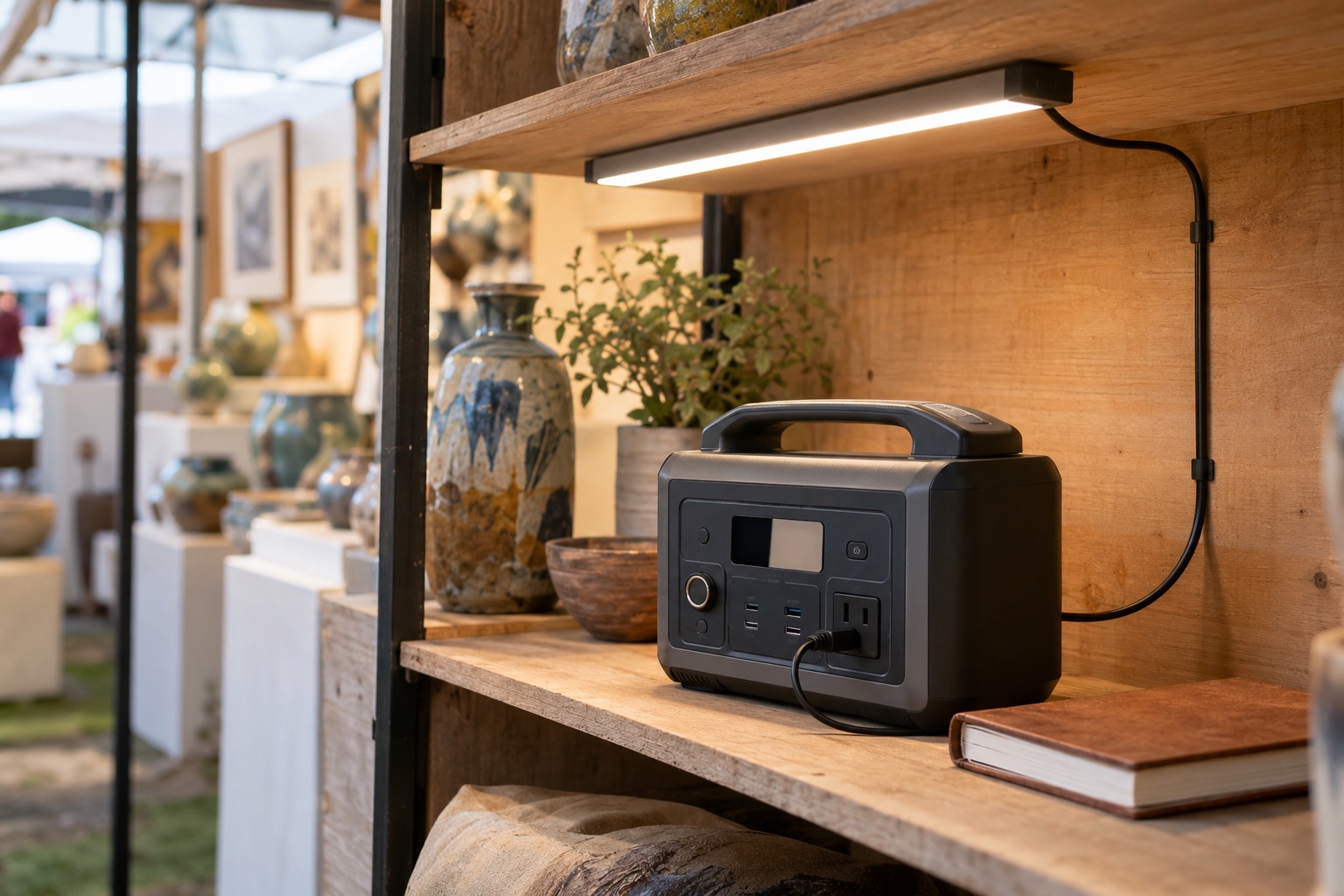
A portable power station can make a booth more independent, but its headline capacity does not tell you whether it will power your particular setup for a full day. Begin with a list of devices and their operating hours. Then compare capacity, output limits, charging arrangements, and the weight you must move.
Understand watts and watt-hours
Watts describe power; watt-hours describe energy used over time. The U.S. Energy Information Administration explains that a one-watt load operating for one hour uses one watt-hour. This distinction matters because a station’s output rating and its stored-energy rating answer different questions.
A station must support the combined power demand of the devices running at once. It also needs enough usable energy for the time you plan to run them. Check the exact model’s output limits and manufacturer instructions, including any restrictions on individual ports or simultaneous outputs.
Build a simple energy worksheet
For a hypothetical booth, four lights drawing 8 watts each would require 32 watts while operating. At eight hours, those lights alone would use 256 watt-hours. Add a hypothetical 20 watt-hours for device charging and the planned device energy becomes 276 watt-hours. These are example numbers, not specifications for your equipment or a promised battery runtime.
Read device labels and measure actual use where possible. Allow for conversion losses, the station’s own consumption, temperature, battery condition, and a reserve. Manufacturer runtime estimates may use particular assumptions; Jackery’s published explanation, for example, applies an efficiency factor rather than treating the label capacity as fully available to the load. Use guidance for the model you are considering.
Check connections before capacity
List the plugs and charging standards your equipment needs. A suitable energy rating will not help if a device cannot use the available output. Include approved chargers and necessary cables in your packing plan. Avoid assuming that every USB-C socket supports the same charging power.
Decide whether checkout can run independently from the lighting battery. A small separate phone power bank may simplify your backup plan, particularly if the main station is exhausted or temporarily unavailable. See our guide to payment preparation when show Wi-Fi fails.
Consider the full show schedule
An eight-hour sales day may involve additional lighting during setup and packing. A two-day event also needs an overnight recharging plan. Ask whether the organizer allows your equipment and whether paid venue electricity is available. Follow the station’s storage, ventilation, charging, and environmental instructions; a canopy does not make indoor-only equipment weatherproof.
Compare the battery’s packed size and lifting weight with your load-in equipment. The charger, cables, and protective transport arrangement belong in that comparison.
Prove the plan before the show
Run the actual lights, chargers, and checkout equipment together for the planned duration. Record the starting charge, settings, elapsed time, and remaining charge. Repeat after changing a major device or lighting setting. A complete rehearsal is a better purchasing guide than a capacity number on its own, and it gives you a practical point at which to switch off nonessential loads.